
India is home to around 1.4 billion people [1]. But access to information here is not evenly distributed, it is shaped by four deep, overlapping divides.
- Literacy divide, nearly one in five Indian adults cannot read or write. Rural literacy hovers around 77.5%, and the gender gap still exceeds 12 percentage points. For millions, text is not an interface, it is a barrier [2].
- Financial divide, India is one of the top contributors to the world’s unbanked adults. Large segments remain outside formal systems, directly affecting how they access services and support [3].
- Digital divide, around 350 million Indians still use feature phones. No apps. No mobile internet. No AI assistants. Smartphone penetration is under 50%, meaning most of the country does not live inside the app economy [4].
- Demographic divide, almost half of Indians above the age of 60 are illiterate. Elderly citizens, rural households and marginalised women often sit at the intersection of all four divides, excluded not by intent, but by design [5].
Four overlapping access divides
Live viewLiteracy divide
77.5%
Rural literacy rate
Nearly one in five adults cannot read or write, and the gender gap still exceeds 12 points. [2]
Financial divide
Top globally
Among the world’s largest unbanked populations
Large segments remain outside formal financial systems, shaping how they reach services. [3]
Digital divide
350M
Indians still on feature phones
Smartphone penetration is under 50%. No apps, no mobile internet, no assistants. [4]
Demographic divide
50%
Of Indians over 60 are illiterate
Elderly, rural and marginalised women often sit at the intersection of all four divides. [5]
Yet almost every AI product today assumes literacy, internet and a smartphone, serving people who are already connected, not those who are excluded. Ironically, the people excluded by this design are often the ones who need AI support most.
“But there is one constant across 1.4 billion Indians. Voice. Literate or not. Connected or not. Urban or rural. Every individual speaks. Every individual listens, in their own language, in their own dialect.”
Telephony integration is stable. The models are there, the pipelines exist, and the demonstrations are impressive. So the question is no longer: ‘Does Voice AI work?’ The harder question is whether it can run as public infrastructure, at population scale, on a government budget, without routing every citizen’s voice through someone else’s data centre.
At the India AI Impact Summit, VoicEra was unveiled as India’s first open-source Voice AI stack, a shift in how voice systems can be built and deployed, in the cloud or on-premises, with institutional ownership and control [9–12].
01, The landscape is ready. The infrastructure model isn’t.
India’s voice ecosystem has reached real technical maturity. AI4Bharat’s Conformer-based Indic speech recognition delivers strong performance across Indian languages. Modern Indic text-to-speech systems sound increasingly natural. Open-source language models can handle complex reasoning, while real-time WebSocket telephony pipelines operate with low latency.
Most voice deployments still follow a familiar pattern: centralised cloud hosting, dependence on H100-class GPUs, ₹2.7–₹6 per-minute recurring costs, audio held outside the originating institution, and significant friction when switching vendors. That model can work for a proof of concept or a limited pilot [6]. As long-term public infrastructure serving millions, it becomes difficult to sustain.
02, Three numbers that change the conversation
Before examining VoicEra, it helps to unpack the scale-level challenges that shape the need for it.
The first is cost, and it compounds fast
At first, ₹2.7–₹6 per minute sounds manageable. Scale changes the equation. India has roughly 40 million farmers [7]. Take Madhya Pradesh, with about three million farmers. If each farmer makes one one-minute call per week, that is 156 million calls a year.
- ₹42.1–₹93.6 Cr
- Annual cost for one state and one use case at the cited cloud rates
- 156M
- Calls per year from three million farmers calling weekly
- ₹1
- Potential effective per-minute cost at sustained appliance volumes
Public systems are not SaaS experiments with variable demand. They are continuous infrastructure. Recurring per-minute billing turns voice into structural operating expenditure that public institutions are not designed to carry.
The second is data, fundamentally a policy question
Voice is not just audio. It carries identity cues, dialect, tone, intent and context. Calls can contain names, phone numbers, land records and grievance details. Under India’s DPDP framework, institutions must answer where audio is stored and processed, whether retention and deletion are enforceable locally, who owns transcripts and logs, and what happens when a vendor relationship ends.
The third is hardware, and the assumptions built into it
Most voice stacks are conceived around hyperscale GPU clusters. District health centres, state agriculture departments and taluk-level offices do not operate like hyperscale cloud. If Voice AI needs enterprise clusters to function, it remains a pilot at the top of the system rather than sovereign infrastructure that reaches the bottom.
Voice inference does not inherently require H100-class hardware. Its sequential, low-batch nature can make mid-tier or consumer-grade GPUs more cost-efficient for real-time deployments. These are not edge cases; they are structural constraints that have kept voice from becoming genuine digital public infrastructure.
03, What VoicEra actually is
VoicEra is not a chatbot. It is a complete, open-source, production-grade Voice AI execution stack spanning hardware and software, delivered as an open Digital Public Good, deployable on shared infrastructure or inside an institution’s own data centre.
The stack covers telephony intake, speech recognition, language-model reasoning and speech output, with modular switching at every layer. It also includes an Agent Builder for use-case behaviour, observability for latency, concurrency and call success, and governance controls for access, logging and retention.
A call, resolved in one continuous loop
Live signalPhone
PSTN · SIP
Speech
STT
Reason
LLM + tools
Voice
TTS
Citizen
Response
VoicEra can run in the cloud, through an API deployment, in an institution’s data centre, or on consumer-grade hardware as Voice-in-a-Box. Of these options, the appliance model changes the economics and control equation most dramatically.
04, Voice-in-a-Box: the part that changes procurement math
Here is the architectural shift: the entire voice pipeline, speech recognition, language-model reasoning, speech generation, orchestration, session management, logging and governance, runs locally, on hardware the institution owns, in infrastructure it controls, with audio that need not leave.
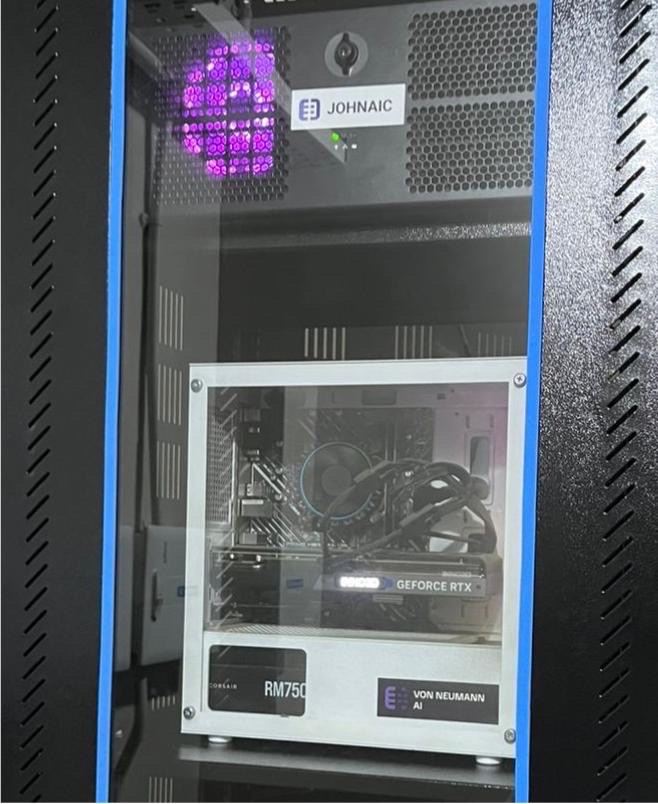
The hardware philosophy is deliberately pragmatic. Instead of assuming centralised H100-class clusters, Voice-in-a-Box is engineered for consumer- or workstation-grade GPUs.
- A single 16GB GPU configuration can handle roughly 4–6 concurrent calls, depending on model mix and translation load.
- For 50–100 simultaneous calls, larger multi-GPU systems and higher-memory configurations support model footprint, batching and stable latency.
- JOHNAIC-class appliance builds are modular nodes that can be installed in state data centres, cooperative networks or institutional environments.
- The stack is containerised, portable and hardware-agnostic. Cloud remains available, but it is no longer the dependency.
| Model | Cost structure |
|---|---|
| Cloud voice stack | ₹2.7–₹6 per minute, recurring indefinitely |
| Voice-in-a-Box | One-time hardware investment; effective per-minute cost can approach ₹1 at sustained volumes |
The data equation changes too. Audio need not leave institutional infrastructure. Retention policies can be enforced directly, logs can be deleted, encryption can remain end-to-end, and role-based access can be configured locally. DPDP alignment becomes demonstrable rather than merely contractual.
06 | VoicEra builds on the power of DPGs
A Digital Public Good is open-source infrastructure designed for public use, transparent governance and freedom from system-level vendor lock-in. India has already seen the power of Digital Public Infrastructure: Aadhaar created an identity layer, UPI created interoperable payment rails, and DIKSHA created a shared digital backbone for education [8].
VoicEra can play a similar role: a sovereign, interoperable conversational layer through which institutions deliver services by speech, not only to people already online, but to everyone. Speech recognition, language-model and speech-generation providers remain swappable without rebuilding the system.
07, The engineering underneath
For the technically inclined, this is not stitched glue code. The stack includes real-time WebSocket telephony, session orchestration with token budgeting, GPU scheduling and load balancing, concurrency scaling from 25–50 calls in Phase 1 toward 50–100 in production targets, noise cancellation and audio normalisation, an Agent Builder for prompting, policy configuration and sandbox testing, and observability across latency, concurrency, GPU utilisation and call success.
More detail on the architecture and measured deployment performance will follow separately.
08, The questions that come next
The questions that adopters, secretaries, CTOs and infrastructure heads, will rightly ask are not about feature lists. They are about operations.
- What happens during seasonal call spikes, when farmers across a state call during the Kharif planting window?
- How are distributed appliance nodes monitored across district offices with variable connectivity?
- What is the rollout protocol for model updates on on-premises deployments?
- How does dialect coverage expand from 22 scheduled languages toward hundreds of spoken variants?
- How are low latency and high concurrency sustained in production, with real-world noise and network variability?
- How will the voice models continue to improve, and how will unsafe language-model hallucinations be reduced?
“Voice infrastructure behaves more like a telecom network than a SaaS product. The failure modes are different, recovery is harder, and tolerance for degraded service is close to zero when the person calling is a farmer asking about crop disease or a citizen filing a grievance.”
The architecture reflects these concerns. But the answers will be visible after the summit, in call volumes, latency logs and deployment reports, not in launch announcements.
The real bet
Voice AI is powerful. Cloud-dependent voice is expensive, centralised and fragile at public scale. Voice-in-a-Box makes it sovereign, affordable, deployable and portable, to the last district, the last taluk, and the last farmer speaking a dialect no enterprise product has optimised for.
VoicEra is the infrastructure layer, the thing underneath the thing, for how public systems will speak to citizens and listen to them at scale. That is a more consequential ambition than launching another bot.
The ambition is credible because it did not remain a white-paper idea. Jagdish Babu and Santosh Kevlani shaped it into something the system could be held accountable to. BHASHINI, EkStep, COSS, IIIT Bengaluru and AI4Bharat brought institutional depth and technical credibility. Under the leadership of Amitabh Nag and the BHASHINI team, VoicEra was formally launched at the India AI Impact Summit 2026 [9–12]. Live deployments gave it something many public AI initiatives rarely have before launch: a working track record.
Sources & further reading
- 1India population ↗
- 2India’s literacy, gender and rural–urban gaps ↗
- 3World Bank Global Findex coverage ↗
- 4Feature-phone and smartphone access in India ↗
- 5Elderly literacy rate in India ↗
- 6Voice-agent platform pricing landscape ↗
- 7Number of farmers in Indian states ↗
- 8Digital public infrastructure overview ↗
- 9PIB press release · PRID 2229732 ↗
- 10India AI Impact Summit 2026 ↗
- 11DD News ↗
- 12News on AIR ↗
Use-case and deployment status reflects information available at the time of the India AI Impact Summit 2026 launch.